If you are new to plyometrics I'd recommend checking out this article from the American Council on Exercise for a quick summary of the risks and benefits.
See you on the beach!
Eric Hand, MA , CSCS
Exercise Physiologist and Strength & Conditioning Specialist
Fast Twitch Fitness
“We’re all athletes. Some of us are just farther along in our training.”
Sunday, February 21, 2010
Sunday, February 14, 2010
Exercise of the Week: Forward Cone Hops
Level: Intermediate
Specificity: Power
Goal: Improving vertical jump
We’ll continue our plyometric training this week with forward cone hops. For those of you new to plyometrics, these movements are designed to enable a muscle to reach maximal force in the shortest time possible, a crucial factor in the beach game.
If you are new to jump training, here are two things to consider. First, it is recommend that you practice bodyweight and back squats with weight to develop lower body strength and proper technique before attempting jumping movements. (Click here for proper squatting technique). Also, the National Strength and Conditioning Association recommends you should be able to squat a least 1.5 times your body weight one time before engaging in high intensity plyometric exercises.(1) Individuals with preexisting orthopedic conditions (such as osteoarthritis or knee surgery) should perform plyometrics cautiously.
Be sure you perform a thorough warm up (click here) before performing the forward cone hops.
Recommended equipment:
Intermediate (> 3months regular strength training experience): (4) six inch cones
Advanced (> 1 year regular strength training experience): (4) ten inch cones
Position the cones two feet apart in a straight line on a non-skid surface. Surfaces like rubber gym mats, grass or sand are safest for this exercise. Avoid performing this movement on harder surfaces like concrete.
Start position – stand facing the line of cones with your feet hip width apart. With arms by your side maintain a flat back as you draw your shoulder blades together and down. Engage your core by gently flexing your abdominal muscles to support your spinal column.
Begin the downward phase by bending at the hips and knees while keeping your weight in your heels. Look straight ahead to maintain a flat back. Draw your arms back while continuing to bring shoulder blades together and down.

At the bottom of the downward phase quickly reverse directions by simultaneously extending through your ankles, knees and hips to explode upwards and forwards over the first cone. The forceful extension through your ankles, knees and hips is referred to as triple extension and is key to maximizing the height of your jump.
As you return to the ground focus on landing softly and quietly. Land on both feet simultaneously and be sure to keep your knees soft. Allow your hips to drop and push backwards to absorb the force of jumping. Think about landing in the middle of the foot and quickly allowing your weight to shift back towards your heels. Maintain a forward gaze with your torso inclined slightly forward.

At the bottom of the downward phase, with as little pause as possible, immediately extend through your ankles, knees and hips simultaneously (triple extension) to explode upwards and forwards over the top of the next cone. As you jump, try to keep your feet level with each other and parallel with the floor.

Repeat until you have jumped over each cone. Rest 90-120 seconds and repeat.
Intermediate- complete 2 sets for a total of 8 jumps
Advanced- complete 3 sets for a total of 12 jumps
Perform this movement once a week for best results.
See you on the beach!
Eric Hand, MA , CSCS
Exercise Physiologist and Strength & Conditioning Specialist
Fast Twitch Fitness
“We’re all athletes. Some of us are just farther along in our training.”
(1) Essentials of strength training and conditioning / National Strength and Conditioning Association (3rd edition), 2008.
Pictures from American Council on Exercise
Specificity: Power
Goal: Improving vertical jump
We’ll continue our plyometric training this week with forward cone hops. For those of you new to plyometrics, these movements are designed to enable a muscle to reach maximal force in the shortest time possible, a crucial factor in the beach game.
If you are new to jump training, here are two things to consider. First, it is recommend that you practice bodyweight and back squats with weight to develop lower body strength and proper technique before attempting jumping movements. (Click here for proper squatting technique). Also, the National Strength and Conditioning Association recommends you should be able to squat a least 1.5 times your body weight one time before engaging in high intensity plyometric exercises.(1) Individuals with preexisting orthopedic conditions (such as osteoarthritis or knee surgery) should perform plyometrics cautiously.
Be sure you perform a thorough warm up (click here) before performing the forward cone hops.
Recommended equipment:
Intermediate (> 3months regular strength training experience): (4) six inch cones
Advanced (> 1 year regular strength training experience): (4) ten inch cones
Position the cones two feet apart in a straight line on a non-skid surface. Surfaces like rubber gym mats, grass or sand are safest for this exercise. Avoid performing this movement on harder surfaces like concrete.
Start position – stand facing the line of cones with your feet hip width apart. With arms by your side maintain a flat back as you draw your shoulder blades together and down. Engage your core by gently flexing your abdominal muscles to support your spinal column.
Begin the downward phase by bending at the hips and knees while keeping your weight in your heels. Look straight ahead to maintain a flat back. Draw your arms back while continuing to bring shoulder blades together and down.

At the bottom of the downward phase quickly reverse directions by simultaneously extending through your ankles, knees and hips to explode upwards and forwards over the first cone. The forceful extension through your ankles, knees and hips is referred to as triple extension and is key to maximizing the height of your jump.
As you return to the ground focus on landing softly and quietly. Land on both feet simultaneously and be sure to keep your knees soft. Allow your hips to drop and push backwards to absorb the force of jumping. Think about landing in the middle of the foot and quickly allowing your weight to shift back towards your heels. Maintain a forward gaze with your torso inclined slightly forward.

At the bottom of the downward phase, with as little pause as possible, immediately extend through your ankles, knees and hips simultaneously (triple extension) to explode upwards and forwards over the top of the next cone. As you jump, try to keep your feet level with each other and parallel with the floor.

Repeat until you have jumped over each cone. Rest 90-120 seconds and repeat.
Intermediate- complete 2 sets for a total of 8 jumps
Advanced- complete 3 sets for a total of 12 jumps
Perform this movement once a week for best results.
See you on the beach!
Eric Hand, MA , CSCS
Exercise Physiologist and Strength & Conditioning Specialist
Fast Twitch Fitness
“We’re all athletes. Some of us are just farther along in our training.”
(1) Essentials of strength training and conditioning / National Strength and Conditioning Association (3rd edition), 2008.
Pictures from American Council on Exercise
Sunday, February 7, 2010
Exercise of the Week: Squat Jump
Exercise of the Week: Squat Jump

Level: Beginner
Specificity: Power
Goal: Improving vertical jump
This is a simple and effective exercise to increase your vertical jump. This exercise is a great movement to start your strength training workouts. Be sure to include at least a 10-minute warm-up prior to performing this exercise. Surfaces like rubber gym mats, grass or sand are safest for squat jumps. Avoid performing this movement on harder surfaces like concrete. If you are new to the squat, I recommend practicing bodyweight squats (without jumping) to learn proper technique before attempting jumping squats.
Go here to see proper squatting technique.
Start position – stand with your feet hip to shoulder width apart, toes angled slightly out. Maintain a flat back as you draw your shoulder blades together and down. Engage your core by gently flexing your abdominal muscles to support your spinal column.

At the bottom of the downward phase quickly reverse directions by exploding upwards and simultaneously extending through your ankles, knees and hips. This movement is referred to triple extension and is key to maximizing the height of your jump.

As you return to the ground think about landing softly and quietly. Land on both feet simultaneously and be sure to keep your knees soft. Allow your hips to drop and push backwards to absorb the force of jumping. Think about landing in the middle of the foot and quickly allowing your weight to shift back towards your heels. Maintain a forward gaze with your torso inclined slightly forward.

Perform 6-12 consecutive squat jumps without stopping between jumps.
See you on the beach!
Eric Hand, MA , CSCS
Exercise Physiologist and Strength & Conditioning Specialist
Fast Twitch Fitness
“We’re all athletes. Some of us are just farther along in our training.”
Pictures from American Council on Exercise.
Sunday, January 24, 2010
Beach Volleyball Boot Camp
Kick start the volleyball season with my Beach Volleyball Boot Camp starting Wednesday, March 24th, 2010.
This five part series of volleyball specific conditioning classes will have you ready for the beach by increasing your speed on the court so you get to the ball faster and improving your recovery after those marathon rallies we all love.
In this class you will:
Remember, it doesn’t matter how good your passing skills are if you can’t get to the ball. I look forward to helping you make this your best beach volleyball season yet!
This five part series of volleyball specific conditioning classes will have you ready for the beach by increasing your speed on the court so you get to the ball faster and improving your recovery after those marathon rallies we all love.
In this class you will:
- Reduce your risk of injury
- Increase your speed and agility in the sand
- Increase your stamina and recovery for the beach game
- Increase your vertical jump
Five consecutive Wednesdays:
March 24h - April 21st
March 24h - April 21st
Main Beach, Santa Cruz, 5:30-6:30 pm
$60 for 5 class series
10% of registrations fees will be donated to Save Our Shores
Class size is limited
Remember, it doesn’t matter how good your passing skills are if you can’t get to the ball. I look forward to helping you make this your best beach volleyball season yet!

Saturday, January 2, 2010
Eight Essential Strength Exercises for Beach Volleyball
With the rainy days of January, February and March the winter months are the perfect time to focus on other components of our game. One of the most important and often overlooked aspects of beach volleyball conditioning is strength. Strength is the maximum force that can be applied by a muscle to perform a given task. Developing a solid strength base is crucial to for improved performance and injury prevention.
As a strength and conditioning specialist one of the most common questions I’m asked is “how can I improve my vertical jump?” Improvement in jumping ability is dependent on two key components: strength and quickness. Quickness training like plyometrics (“jump training”) and explosive lifting exercises are important, but they are also very demanding on the body and if we have not developed a strong enough base we are increasing our risk of injury. Strength training is where it all must begin.
So, how can you build that solid strength base? The key to results is dependent on one key ingredient, QUALITY! The quality of the exercises you perform will determine your success. Not all strength training exercises are created equal and as you might imagine the movements that work for a football player, a baseball player or a bodybuilder may not deliver the results an avid volleyball player desires.
So, what are the best exercises for developing strength and creating a base for power development for the beach volleyball game? I’m so glad you asked.
Eight Essential Strength Exercises
Here are my Eight Essential Strength Exercises listed in the order in which they should be performed during your workout.
1) The Back Squat – this is the granddaddy of lower body exercises. Not only is it very effective for developing lower body strength but the movement also closely resembles key movements for the beach game.

2) The Lunge – this exercise not only develops strength in our lower body but will also help develop balance and core strength

3) The Step Up – this is a great alternative for volleyball players with hip or knee problems. The height of the step can be changed to modify exercise intensity.

4) The Push-up – this exercise is great for developing upper body strength and shoulder stability. Incorporating this exercise enables us to pop back up out of the sand and be ready for that always gratifying third hit.

5) The Pull-up/Horizontal Pull Up – What the squat is to the lower body the pull-up is to the upper body. Pull Ups are an essential exercise for developing upper body and overhead strength. Hoisting our body weight up repeatedly takes significant strength however, and if we’ve been avoiding the gym like the plague we may need to work up to the pull up. The horizontal pull up (think opposite of chest press) is a great alternative for developing strength in the upper and mid back.

6) The Military (Overhead) Press – this is an important movement for developing overhead strength and shoulder stability.

7) The Russian Twist – a great movement to develop the obliques which are crucial to rotation and follow through on the serve and third hit.

8) The Reverse hyperextension on ball – this is a very effective exercise to strengthen the lower back and glutes and a crucial movement to balance all of those crunches and situps we’ve done through the years.

Pictures from American Council on Exercise and Men's Health. For detailed instructions on each exercise visit the American Council on Exercise website.
To determine the appropriate training volume (frequency, sets, reps)
for you see below. When you can successfully complete 12 repetitions of an exercise for two consecutive workouts increase the resistance 5% for upper body exercises or 10% for lower body exercises.
Beginner (less than 2 months of strength training experience): 2-3 sessions per week, 1-3 sets per exercise, 8-12 repetitions per set
Intermediate (2-11 months of strength training experience): 3-4 sessions per week, 2-4 sets per exercise, 8-12 repetitions per set
Advanced (1 year or more of strength training experience): 4-7 sessions per week, 3-5 sets per exercise, 8-12 repetitions per set
Keys to Successful Strength Training
1) Consistency is key – your progress and results will be directly affected by your training consistency
2) Focus on Form - it’s important to remember to never sacrifice your form and technique simply to lift a heavier weight. Not only does it increase our risk of injury but as Roland says “you just look stupid.”
3) Remember to Breathe – you’d think that by the time we’ve reached 20, 30, 60 years of age we’d have this one down, but put a weight in someone’s hand and you’d be surprised how quickly they forget. A good breathing cue to remember while strength training is to exhale on effort.
4) ROM = MORE – to maximize the benefit of the movement work through a full range of motion (ROM) as much as possible.
Perform these movements consistently for an 8-12 week period and you’ll be well on your way to developing a solid strength base which will be crucial for our next topic – Developing your Vertical Jump.
These simple and effective strength training exercises will help you build a solid foundation of strength and prepare your muscles for the high demands of the beach game. Your opponents won’t know what hit them. Straight down!
See you on the beach!
Eric Hand, MA , CSCS
Exercise Physiologist and Strength & Conditioning Specialist
Fast Twitch Fitness
“We’re all athletes. Some of us are just farther along in our training.”
As a strength and conditioning specialist one of the most common questions I’m asked is “how can I improve my vertical jump?” Improvement in jumping ability is dependent on two key components: strength and quickness. Quickness training like plyometrics (“jump training”) and explosive lifting exercises are important, but they are also very demanding on the body and if we have not developed a strong enough base we are increasing our risk of injury. Strength training is where it all must begin.
So, how can you build that solid strength base? The key to results is dependent on one key ingredient, QUALITY! The quality of the exercises you perform will determine your success. Not all strength training exercises are created equal and as you might imagine the movements that work for a football player, a baseball player or a bodybuilder may not deliver the results an avid volleyball player desires.
So, what are the best exercises for developing strength and creating a base for power development for the beach volleyball game? I’m so glad you asked.
Eight Essential Strength Exercises
Here are my Eight Essential Strength Exercises listed in the order in which they should be performed during your workout.
1) The Back Squat – this is the granddaddy of lower body exercises. Not only is it very effective for developing lower body strength but the movement also closely resembles key movements for the beach game.

2) The Lunge – this exercise not only develops strength in our lower body but will also help develop balance and core strength

3) The Step Up – this is a great alternative for volleyball players with hip or knee problems. The height of the step can be changed to modify exercise intensity.

4) The Push-up – this exercise is great for developing upper body strength and shoulder stability. Incorporating this exercise enables us to pop back up out of the sand and be ready for that always gratifying third hit.

5) The Pull-up/Horizontal Pull Up – What the squat is to the lower body the pull-up is to the upper body. Pull Ups are an essential exercise for developing upper body and overhead strength. Hoisting our body weight up repeatedly takes significant strength however, and if we’ve been avoiding the gym like the plague we may need to work up to the pull up. The horizontal pull up (think opposite of chest press) is a great alternative for developing strength in the upper and mid back.

6) The Military (Overhead) Press – this is an important movement for developing overhead strength and shoulder stability.

7) The Russian Twist – a great movement to develop the obliques which are crucial to rotation and follow through on the serve and third hit.

8) The Reverse hyperextension on ball – this is a very effective exercise to strengthen the lower back and glutes and a crucial movement to balance all of those crunches and situps we’ve done through the years.

Pictures from American Council on Exercise and Men's Health. For detailed instructions on each exercise visit the American Council on Exercise website.
To determine the appropriate training volume (frequency, sets, reps)
for you see below. When you can successfully complete 12 repetitions of an exercise for two consecutive workouts increase the resistance 5% for upper body exercises or 10% for lower body exercises.
Beginner (less than 2 months of strength training experience): 2-3 sessions per week, 1-3 sets per exercise, 8-12 repetitions per set
Intermediate (2-11 months of strength training experience): 3-4 sessions per week, 2-4 sets per exercise, 8-12 repetitions per set
Advanced (1 year or more of strength training experience): 4-7 sessions per week, 3-5 sets per exercise, 8-12 repetitions per set
Keys to Successful Strength Training
1) Consistency is key – your progress and results will be directly affected by your training consistency
2) Focus on Form - it’s important to remember to never sacrifice your form and technique simply to lift a heavier weight. Not only does it increase our risk of injury but as Roland says “you just look stupid.”
3) Remember to Breathe – you’d think that by the time we’ve reached 20, 30, 60 years of age we’d have this one down, but put a weight in someone’s hand and you’d be surprised how quickly they forget. A good breathing cue to remember while strength training is to exhale on effort.
4) ROM = MORE – to maximize the benefit of the movement work through a full range of motion (ROM) as much as possible.
Perform these movements consistently for an 8-12 week period and you’ll be well on your way to developing a solid strength base which will be crucial for our next topic – Developing your Vertical Jump.
These simple and effective strength training exercises will help you build a solid foundation of strength and prepare your muscles for the high demands of the beach game. Your opponents won’t know what hit them. Straight down!
See you on the beach!
Eric Hand, MA , CSCS
Exercise Physiologist and Strength & Conditioning Specialist
Fast Twitch Fitness
“We’re all athletes. Some of us are just farther along in our training.”
Sunday, August 16, 2009
Training for Explosiveness in the Sand
Beach volleyball is a sport dominated by quick, explosive movements. You can have great volleyball fundamentals, but if you aren’t fast enough to get to the ball, you won’t be able to make that perfect pass. The quicker we are in the sand the better we can get into proper position to pass that perfect pass to our partner who in turn can give us that buttery set we all love. In this issue we’ll discuss how to increase our explosiveness in the sand.Recommended Work:Rest intervals
SKATERS: This is a great exercise for the glutes. Stand tall with feet at least shoulder width apart. Shift weight to left leg while bending your left knee. Swing arms to the left as you bring your right leg behind your left. Quickly switch sides by pushing off from your left leg and hopping towards your right. Land on your right leg and allow your left leg to swing behind and your arms to swing naturally to the right. Repeat back and forth for the allotted time: Beginners – 20:40 (20 seconds on, 40 seconds rest)
DIAMOND JUMPS: Draw four small Xs, 11/2 to 2 feet apart from each other in a shape of diamond. Start by standing at the top of the diamond. Keeping ankles together, jump clockwise in a diamond pattern. Land on the balls of your feet and use a double arm swing to stabilize your body. Switch directions at the halfway point (10 seconds for beginners, 15 seconds for intermediate) and jump counterclockwise for the remainder of the time. Remember, the point of this is to increase speed, so concentrate on getting as many hops as you can in the allotted time (Beginners – 20:40 (20 seconds on, 40 seconds rest) Intermediate – 30:30 (30 seconds on, 30 seconds rest)
He Sticks the Landing! Judges Score: a Perfect 10!
Before performing these movements be sure to warm-up thoroughly using the exercises presented in the last two issues (http://fasttwitchfitness.blogspot.com/). Starting with high knees, perform each movement for the desired time (see below), rest, and then move onto the next movement. You will be performing a circuit of four movements. The goal is to perform these movements as quickly as you can for the allotted time. Maintain your speed as best you can throughout the allotted time.
If you have pre-existing injuries skip any movements that do not seem appropriate for you.
Recommended Work:Rest intervals
Beginners – 20:40 (20 seconds on, 40 seconds rest)
Intermediate – 30:30 (30 seconds on, 30 seconds rest)
And Intermediates do – 30:30 (30 seconds on, 30 seconds rest)

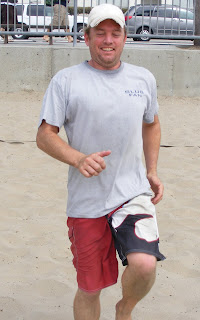
By the way, it helps if you can be in a good mood while doing these exercises, like this cheery guy!
SKATERS: This is a great exercise for the glutes. Stand tall with feet at least shoulder width apart. Shift weight to left leg while bending your left knee. Swing arms to the left as you bring your right leg behind your left. Quickly switch sides by pushing off from your left leg and hopping towards your right. Land on your right leg and allow your left leg to swing behind and your arms to swing naturally to the right. Repeat back and forth for the allotted time: Beginners – 20:40 (20 seconds on, 40 seconds rest)
Intermediate – 30:30 (30 seconds on, 30 seconds rest)


IN AND OUTS: Stand tall with feet wider than shoulder width apart. Step your right foot in and then step your left foot in. Next step your right foot out wide and follow it by stepping the left foot wide. Repeat for the desired time. If your dance moves are more Elaine Benes than Britney Spears, it may help to say “in-in-out-out” while performing this movement. Concentrate on moving your feet as fast as possible. Beginners, do this move for – 20:40 (20 seconds on, 40 seconds rest) and Intermediates, do – 30:30 (30 seconds on, 30 seconds rest)


DIAMOND JUMPS: Draw four small Xs, 11/2 to 2 feet apart from each other in a shape of diamond. Start by standing at the top of the diamond. Keeping ankles together, jump clockwise in a diamond pattern. Land on the balls of your feet and use a double arm swing to stabilize your body. Switch directions at the halfway point (10 seconds for beginners, 15 seconds for intermediate) and jump counterclockwise for the remainder of the time. Remember, the point of this is to increase speed, so concentrate on getting as many hops as you can in the allotted time (Beginners – 20:40 (20 seconds on, 40 seconds rest) Intermediate – 30:30 (30 seconds on, 30 seconds rest)


He Sticks the Landing! Judges Score: a Perfect 10!
Whew! Rest 1-2 minutes and then repeat the circuit. Yes, repeat it!
If you perform these exercises regularly (2-3 times a week), you will notice your speed increasing and it will become easier to go for longer durations for each exercise. These simple and effective exercises will prepare your muscles for the high demands of the beach game and your opponents won’t know what hit them!
See you on the beach!
Eric Hand, MA , CMT
Clinical Exercise Physiologist
Fast Twitch Fitness
Monday, May 4, 2009
Volleyball Conditioning Warm Up #2
In this edition we’ll continue developing an efficient and effective warm-up for the beach game. A quick observation of beach volleyball clearly indicates that power is a key component to our success. As the power needs of the sport increase so does the importance of the warm-up. If we are expecting our body to react and sprint, dive and jump in that first play it would be wise of us to do a little prep work first.
A simple, focused lower body warm-up can increase muscle temperature and blood flow to our leg muscles allowing for faster muscle contraction, force development and reaction time. An effective warm-up can be completed in as little as 8-12 minutes. Think of this time as an investment to both reduce your risk of injury and prepare your body for the explosive demands that will be placed on it as soon as the first ball is served.
High knee walk
This movement is designed to wake up those hamstrings and hip flexors. Start on the right side line and face the left side line. Lift your right knee high (to approximately 90 degrees of hip and knee flexion) while bringing your left hand near your left ear. Step down with your right leg and immediately bring your left knee and right hand up. Continue walking across the court like this until you’ve reached the left side line, turnaround and repeat to the right side line.

High knee run
This movement is very similar to the high knee walk, however this time we’ll add a quick hop as we step down. Start on the right side line and face the left side line. Lift your right leg high (to approximately 90 degrees of hip and knee flexion) while bringing your left hand near your left ear. Step down with your right leg bringing your left knee and right hand up and immediately taking a small hop on your right leg. Switch legs, this time taking a small hop with your left leg. Continue until you’ve reached the left side line, turnaround and repeat to the right side line.

Shuffle
Start by facing the net on the right side line and lower into an athletic stance with a slight bend at the hips and knees. Leading with the left foot, sidestep pushing off with the right foot. Shuffle toward the left side line making sure you do not cross your feet. Keep your shoulders square and your gaze towards the net in front of you. Gradually work to lower your stance while you shuffle.


Carioca or Grapevine (advanced)
A great movement to warm-up those hips and improve range of motion in the trunk. Start by facing the net on the right side line and hold your arms out to the side in a T position. Run laterally (toward the left side line) by crossing your right foot in front of your left and then quickly stepping your right foot behind your left (side step, crossover step, side step, crossover behind). Allow your hips to rotate and your arms to follow. Be sure to keep the knee high as it crosses the body and hold your upper body relatively stationary.


These simple and effective warm-up exercises will prepare your muscles for the high demands of the beach game and your opponents won’t know what hit them. Straight down!
See you on the beach!
Eric Hand, MA , CMT
Clinical Exercise Physiologist
Fast Twitch Fitness
“We’re all athletes. Some of us are just farther along in our training.”
A simple, focused lower body warm-up can increase muscle temperature and blood flow to our leg muscles allowing for faster muscle contraction, force development and reaction time. An effective warm-up can be completed in as little as 8-12 minutes. Think of this time as an investment to both reduce your risk of injury and prepare your body for the explosive demands that will be placed on it as soon as the first ball is served.
High knee walk
This movement is designed to wake up those hamstrings and hip flexors. Start on the right side line and face the left side line. Lift your right knee high (to approximately 90 degrees of hip and knee flexion) while bringing your left hand near your left ear. Step down with your right leg and immediately bring your left knee and right hand up. Continue walking across the court like this until you’ve reached the left side line, turnaround and repeat to the right side line.

High knee run
This movement is very similar to the high knee walk, however this time we’ll add a quick hop as we step down. Start on the right side line and face the left side line. Lift your right leg high (to approximately 90 degrees of hip and knee flexion) while bringing your left hand near your left ear. Step down with your right leg bringing your left knee and right hand up and immediately taking a small hop on your right leg. Switch legs, this time taking a small hop with your left leg. Continue until you’ve reached the left side line, turnaround and repeat to the right side line.

Shuffle
Start by facing the net on the right side line and lower into an athletic stance with a slight bend at the hips and knees. Leading with the left foot, sidestep pushing off with the right foot. Shuffle toward the left side line making sure you do not cross your feet. Keep your shoulders square and your gaze towards the net in front of you. Gradually work to lower your stance while you shuffle.


Carioca or Grapevine (advanced)
A great movement to warm-up those hips and improve range of motion in the trunk. Start by facing the net on the right side line and hold your arms out to the side in a T position. Run laterally (toward the left side line) by crossing your right foot in front of your left and then quickly stepping your right foot behind your left (side step, crossover step, side step, crossover behind). Allow your hips to rotate and your arms to follow. Be sure to keep the knee high as it crosses the body and hold your upper body relatively stationary.


These simple and effective warm-up exercises will prepare your muscles for the high demands of the beach game and your opponents won’t know what hit them. Straight down!
See you on the beach!
Eric Hand, MA , CMT
Clinical Exercise Physiologist
Fast Twitch Fitness
“We’re all athletes. Some of us are just farther along in our training.”
Subscribe to:
Posts (Atom)

