Showing posts with label stretching. Show all posts

Friday, July 9, 2010

Exercise of the Week: Happy, Healthy Knees Part II

Level: Beginner to Advanced

Specificity: Hamstring flexibility

Goal: Injury prevention/rehabilitation

Equipment: Stool


Last week we discussed patellar tendinitis or "jumper's knee", the most common overuse injury for volleyball players. The anatomy of the knee can be seen here.

This week we'll introduce the standing hamstring stretch, an excellent exercise for prevention and rehabilitation of patellar tendinitis. Static stretching exercises should be performed after a thorough warm-up, demonstrated here.


Start position: Stand in front of a stool, about 15 inches high, with pelvis and shoulders square to the stool. Place the heel of your right leg on a stool with toes pointed up to the ceiling. Keep your right leg straight, or place a micro-bend in the knee if you are prone to hyper-extension of the knee.

Ensure that the left foot is pointed straight ahead.

Reach the crown of your head to the ceiling, creating length in your spine as you slowly hinge at the hips, leaning forward until you feel a mild stretch in the back of your right thigh.

As you lean forward, lead with your chest and look straight ahead, ensuring that you keep your spine long and back flat.

Hold the stretch for 15 to 30 seconds or 3 to 5 deep breaths. Switch legs and repeat 3 times for each side. It is important to just stretch to the point of mild tension and not to over stretch, or hyperextend the knee during this movement. The goal is not touch your toes, but to feel a mild stretch in the hamstrings.

Incorporate the standing hamstring stretch into your routine 3-7 times per week.

Thanks for reading and be sure to check back for the next exercise in our series on Healthy, Happy Knees.


See you on the beach!

Eric Hand, MA, CSCS
Exercise Physiologist and Strength and Conditioning Specialist
Fast Twitch Fitness

"We're all athletes. Some of us are just farther along in our training."

Pictures from floota.com

Sunday, June 20, 2010

Exercise of the Week: Scapular Protraction-Retraction

Level: Beginner to Advanced

Specificity: Shoulder stability and strength

Goal: Injury prevention

Equipment: None

This week we'll continue our series on shoulder stability with Scapular Protraction-Retraction. I apologize if the name of this movement brings back haunting memories of high school geometry. The Scapular protraction-retraction movement is designed to promote stability and strength in the shoulder joint. The shoulder joint
provides the greatest range of motion of any joint in the human body, but you already knew that from my last few posts. Right?

Anatomy of the shoulder and rotator cuff can be seen here:


Maintaining a healthy shoulder is crucial to success and longevity in volleyball as the shoulder is involved in all the major skills - serving, setting, digging, blocking and hitting. Research shows that weakness and fatigue of scapular-stabilizing muscles (trapezius, rhomboids, serratus anterior) can lead to pain and a decrease in rotator cuff strength. Our exercise this week will promote proper functioning of the scapula.


Start position: Assume a push-up position with hands directly under shoulders and back flat.

Keeping arms straight, retract shoulder blades by squeezing them together as if you were squeezing a tennis ball between them.

Do not go all the way down as you would with a regular push up. This is a rather subtle movement, designed to isolate and strengthen the scapula stabilizers. You will only move a matter of 1-3 inches for this exercise.

Complete the movement by protracting shoulder blades (spread them apart). Now that was easy wasn't it?

Begin with 10-20 repetitions and work up to 50.

To stabilize your scapula and reduce the strain in your neck and upper shoulders incorporate this movement into your routine 1-2 times per week.

Thanks for reading and be sure to check back next week for more beach volleyball conditioning exercises.


See you on the beach!

Eric Hand, MA, CSCS
Exercise Physiologist and Strength and Conditioning Specialist
Fast Twitch Fitness

"We're all athletes. Some of us are just farther along in our training."

Pictures from crossfitinvictus.com fitnessspotlight.com

Sunday, June 13, 2010

Exercise of the Week: The Sleeper Stretch

Level: Beginner to Advanced

Specificity: Shoulder stability and mobility

Goal: Injury prevention

Equipment: None

This week we'll continue our series on shoulder stability with the Sleeper stretch. No, this does not mean lying down on the couch and dozing off after a long day of volleyball. The Sleeper stretch is a static stretch designed to promote mobility in the shoulder joint.


The shoulder joint provides the greatest range of motion of any joint in the human body.
Maintaining a healthy shoulder is crucial to success and longevity in volleyball as the shoulder is involved in all the major skills - serving, setting, digging, blocking and hitting.

The repetitive actions of serving and hitting in beach volleyball can cause the posterior capsule of the shoulder to tighten over time causing a loss of internal rotation. This loss in mobility can add stress to the musculature of the shoulder joint, increasing our risk of injury.

Any program designed to promote the health and longevity of the shoulder should include a balance of strengthening and stretching exercises. For many of my clients the value of stretching is often overlooked. I don't call stretching the flossing of the exercise world for nothing. It might not always be fun but it's imperative to keeping yourself injury free. Chronically shortened muscles lead to stress, decreased performance, pain and injury. So, if it's been a while since you've "flossed" your shoulders, try this weeks exercise.

The anatomy of the shoulder and rotator cuff can be seen here:


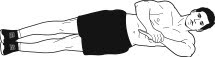
Start position: Lie on your left side forming a straight line with your body. Your shoulders should be stacked directly on top of one another. You may want to use a foam roller or pillow to support your head. Use your left arm as a kickstand by placing your upper left arm on the floor with your fingers pointing to the ceiling. You should have a 90-degree angle with your left arm.


Use your right hand to apply gentle pressure on your left forearm, pushing it towards the floor, without allowing your upper arm to rise.

This is a relatively subtle stretch. Don't expect to be able to place your hand on the floor. Getting to 45-degrees would be...a stretch (ha, ha!) for most athletes.

Hold the stretch for 15-30 seconds. Repeat 3-5 times and switch sides.

Stretching is best performed at the end of a workout after you are thoroughly warmed-up. Include the Sleeper stretch 2-3 times per week as part of your post play routine and before that well deserved nap. Zzzzzzz...........

Thanks for reading and be sure to check back next week for more beach volleyball conditioning exercises.

See you on the beach!

Eric Hand, MA, CSCS
Exercise Physiologist and Strength and Conditioning Specialist
Fast Twitch Fitness

"We're all athletes. Some of us are just farther along in our training."

Exercise picture from www.menshealth.com

Sunday, May 30, 2010

Exercise of the Week: Subscapularis Stretch

Level: Intermediate to Advanced

Specificity: Shoulder stability

Goal: Injury prevention

Muscles Used: Subscapularis, Pectoralis Major, Deltoids


Equipment: Broomstick

This week we'll continue our series on shoulder stability.
The shoulder joint provides the greatest range of motion of any joint in the human body. Maintaining a healthy shoulder is crucial to success and longevity in volleyball as the shoulder is involved in all the major skills - serving, setting, digging, blocking and hitting. However, frequent use of a joint that provides such a wide range of motion can increase our risk for injury.

Any program designed to promote the health and longevity of the shoulder should include a balance of strengthening and stretching exercises.
For many of us the value of stretching is often overlooked. One of my clients put it best - "stretching is like the flossing of the exercise world, it's something that we know we should do but don't do enough." If it's been a while since you've "flossed" your shoulders, I encourage you to try this weeks exercise.

The anatomy of the shoulder and rotator cuff can be seen here:


Our focus this week will be on maintaining/increasing the range of motion of the internal rotators of the shoulder, including the subscapularis, pectoralis major, and deltoid muscles.


Start position: Stand and hold a broomstick or pole in your left arm.


Place your left arm against your abdomen with your left thumb up, pinky down.

Raise your right arm and reach back to grab the broomstick with your right pinky up, thumb down. The broomstick should rest against the back of your right arm.

Position your right arm so that your upper arm (humerus) is parallel to the ground and your forearm is perpendicular to the ground. You should have a 90 degree angle at the elbow.


With your left hand slowly pull the bottom of the broomstick forward until you feel a gentle stretch along the front of the shoulder and underneath your right shoulder blade (scapula).

Hold the stretch for 15-30 seconds and repeat 3-5 times.

Stretching is best performed at the end of a workout after you are thoroughly warmed-up. Include the Subscapularis stretch 2-3 times per week when you get back from the beach and while you're at it, sweep up all that sand you just dragged in!

Thanks for reading and be sure to check back next week for part III of our series on shoulder stabilization for injury prevention.

See you on the beach!

Eric Hand, MA, CSCS
Exercise Physiologist and Strength and Conditioning Specialist
Fast Twitch Fitness

"We're all athletes. Some of us are just farther along in our training."

Exercise pictures from www.floota.com


Monday, February 16, 2009

Kick, stretch and kick!

When to stretch? Before? During? After?

One of my clients said it best, “stretching is the flossing of the exercise world.” We know we probably should, but rarely take the time. How important is stretching and when is the best time to stretch?

A warm-up for beach volleyball should prepare us for training or competition. This preparation time ideally improves our performance and reduces our risk of injury. Stretching used to be considered a vital part of this warm-up. However, there is little to no evidence that stretching before training or competition prevents injury or muscle soreness. In fact, recent research suggests that stretching can actually hinder our performance by impeding force, power, speed and reaction time. I don’t know about you but I don’t need anything else to slow me down or reduce my ability to jump.

While the ideal warm-up does not include stretching, don’t throw out the floss quite yet. Stretching does play a role in our conditioning program, because inflexibility and imbalances in flexibility can increase our risk for injury. So when is the best time to stretch? For optimal benefits we should stretch 5-10 minutes post-training and competition. At this point our muscles are warm and more able to stretch. We may also want to include a separate session for stretching each week if we’re inflexible. The day after a competition is a great time for this. For some examples on stretches to include visit: http://volleyballpr.tripod.com/id2.html

In summary, here a three things to keep in mind about stretching:

- Ideally, stretching should not be included in our pre-training or competition warm-up
- The best time to stretch is 5-10 minutes after training or competition
- Inflexibility and imbalances in flexibility can increase our risk for injury

Until next time…See you on the beach Stretch!

Eric Hand, MA , CMT
Exercise Physiologist
Fast Twitch Fitness

“We’re all athletes. Some of us are just farther along in our training.”